UNESCAP – NICCI – MoPIT Convene National Workshop on Advancing Sustainable Transport Corridors for Landlocked Developing Countries in Nepal
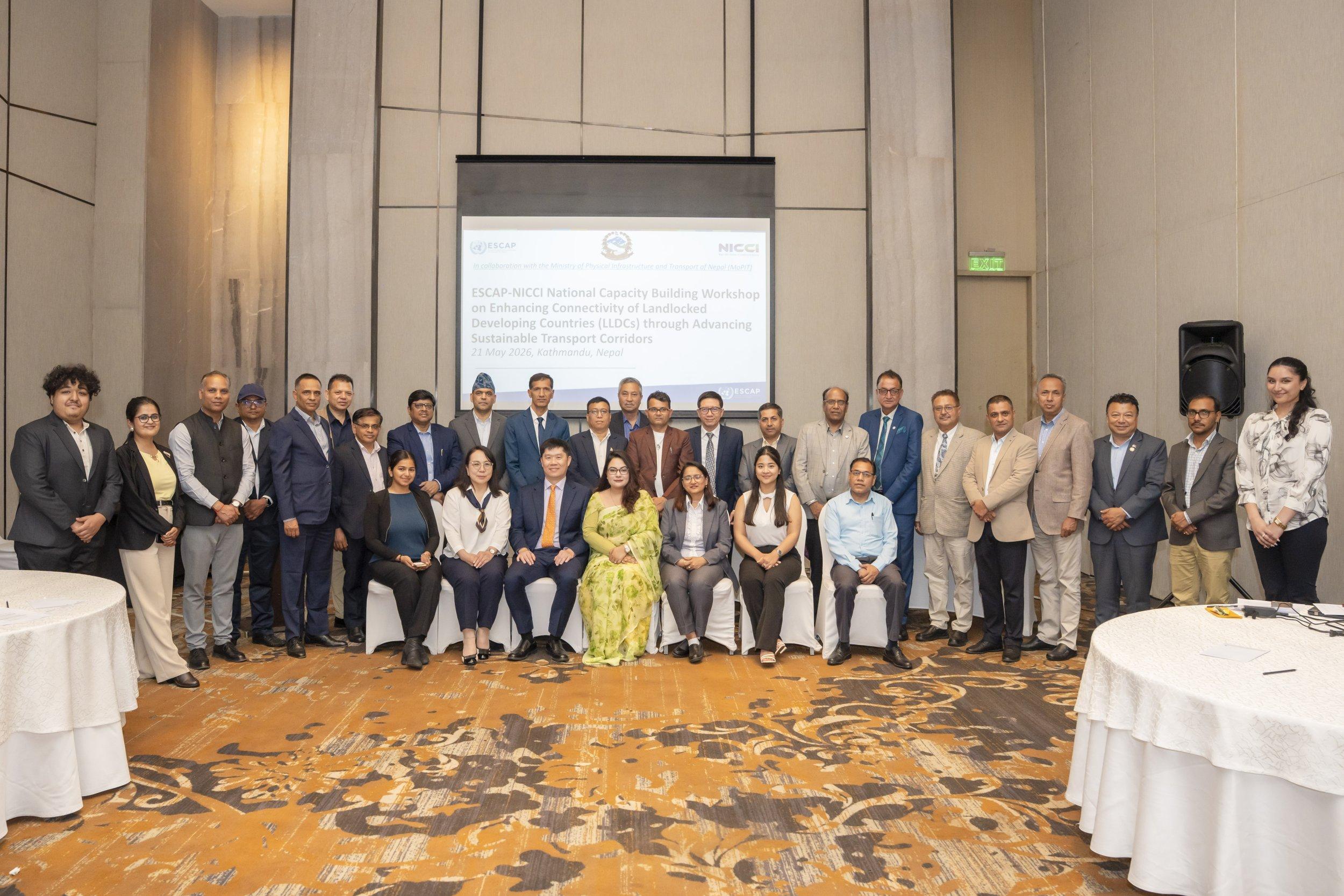
Kathmandu, Nepal, 21 May 2026 - The United Nations Economic and Social Commission for Asia and the Pacific (UNESCAP), in collaboration with the Nepal-India Chamber of Commerce and Industry (NICCI) and the Ministry of Physical Infrastructure and Transport (MoPIT), convened a National Capacity Building Workshop on Enhancing Connectivity of Landlocked Developing Countries (LLDCs) through Advancing Sustainable Transport Corridors on 21 May 2026 at Marriott Hotel, Naxal, Kathmandu.
The one-day workshop brought together a cross-section of policymakers, transport economists, trade facilitation specialists, logistics professionals, and regional stakeholders to examine the structural challenges and opportunities facing landlocked developing countries, with Nepal at the centre of deliberations.
Designed to build national and institutional capacity, the workshop sought to advance frameworks for seamless, sustainable, and digitally enabled connectivity — an agenda of particular relevance for Nepal, whose geographic position as a landlocked nation makes robust transport and transit infrastructure a precondition for broader economic participation in regional and global value chains.
Technical sessions across the day covered a range of policy-critical themes, from the development of sustainable transport corridors and regional connectivity frameworks to the adoption of paperless trade, green port protocols, sustainable shipping practices, and digital logistics systems.
Discussions examined pathways for reducing trade costs, minimising transit delays, and lowering carbon emissions - placing climate-responsible logistics and digital transformation as twin priorities for modern connectivity governance. Edouard Chong of ESCAP presented international frameworks and best practices for LLDC connectivity, setting the analytical tone for the proceedings. Bhimarjun Adhikary, Joint Secretary of MoPIT, and Gaurav Tayal, Vice President of NICCI addressed Nepal's institutional context and the policy imperatives for advancing transport sector reform.
Dr. Prabir Deof the Research and Information System for Developing Countries (RIS, India) contributed a regional economic perspective on South Asian integration and cross-border cooperation. Dr. Delgernasan Mishig of Mongolia brought comparative insights from another landlocked developing country navigating similar transit challenges. Former Secretary Madhu Marasani, Alex Tran, and Joint Secretary of Ministry, Industry Commerce & Supplies (MoICS)Umesh Bindu Shrestha each contributed technical expertise across sessions addressing logistics modernisation, interoperability of transport systems, and the institutional arrangements required to support regional cooperation among South Asian and broader Asian economies.
The workshop carries direct significance for Nepal's ongoing efforts to strengthen trade competitiveness, develop climate-resilient infrastructure, and deepen its integration into regional economic architecture. As a country dependent on transit arrangements with neighbouring states of India and China, Nepal stands to gain substantially from coordinated multilateral efforts to harmonise transport regulations, expand digital trade infrastructure, and formalized sustainable corridor agreements across the region.
The exchanges convened through this workshop underscore the value of structured public-private collaboration - bringing together intergovernmental bodies, national ministries, chambers of commerce, and specialized research institutions around a shared connectivity agenda.
Going forward, participants called for sustained policy coordination, investment in green and digital logistics capacity, and deeper engagement with regional frameworks to translate the workshop's technical findings into actionable reforms. For landlocked developing countries seeking resilient, low-emission, and digitally integrated trade systems, the UNESCAP-NICCI workshop marks a meaningful step in building the institutional consensus and technical foundations that durable connectivity reform demands.